
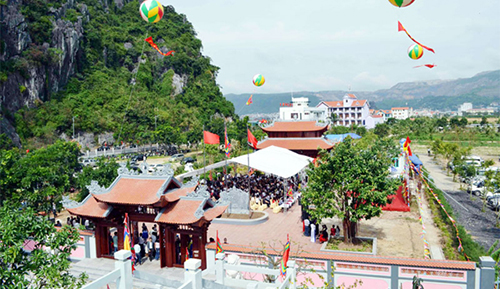
Right in the heart of Cam Pha, on the shore of Bai Tu Long Bay at the foot of Ban Co mountain, the Vung Duc historical and scenic site lets you pay tribute to a tragic and heroic chapter in the mining region’s history, explore five caves and take in the bay from high above.
The Vung Duc martyrs’ temple and memorial
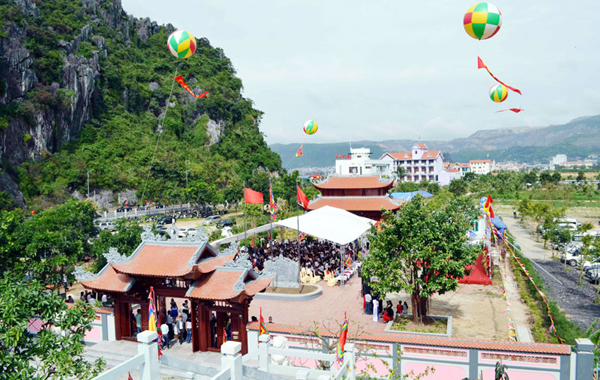
The site lies in Cam Pha ward (formerly Cam Dong ward), next to Vung Duc port, and can be reached by both road and water. Vung Duc was classified as a provincial-level relic in 1999 and comprises Vung Duc Temple, the martyrs’ temple, the memorial and a system of five caves; it is also one of the five Cam Pha tourist sites recognised by the Provincial People’s Committee.

The site is linked to the years 1948–1949, when many cadres, miners and patriotic residents of the Cam Pha mining area were drowned at Vung Duc by the French colonial forces. Although brutally tortured, these steadfast miners refused to talk, protecting the Party organisation and the revolutionary movement. The memorial was erected in 1993 and restored in 2021; the martyrs’ temple stands right beside it, and visitors come here to light incense in memory of the mining region’s courageous sons and daughters.
Five caves on the mountainside
After a moment of remembrance, the visit continues to the five caves: Thien Dang Grotto, Long Van Grotto, Ngo Ngang Grotto, Kim Quy Cave and Bat Cave (Cung Dinh Grotto). The path up to the caves follows the mountainside with hundreds of stone steps, so wear comfortable shoes. A tour of all five caves takes about 1.5 hours.
Thien Dang Grotto
The first stop sits about 46 m above sea level and covers nearly 300 m². From here you can see the whole of Bai Tu Long Bay, its rocky islands rising from the deep blue water. Inside, curtains of rock hang down in folds like a great stage; the stalactites on the ceiling look like crystal chandeliers, sparkling whenever sunlight streams in.
Long Van Grotto
Higher than Thien Dang (about 50 m above sea level), Long Van Grotto splits into an upper and a lower branch. Depending on your imagination, the rocks here turn into an elephant, a swan, a bell, a lotus pedestal… The grotto also has large rock basins holding many “young” stones of different sizes, which locals call the “gold store”.
Kim Quy Cave and Ngo Ngang Grotto
Leaving Long Van and following the main path, you reach Kim Quy Cave and Ngo Ngang Grotto – two smaller caves. Here the stalactites recall the fairy tale of the Hundred-Knot Bamboo Tree, with the shape of a bamboo stem and three curious seated figures in a row.
Bat Cave (Cung Dinh Grotto)
The last stop is Bat Cave, also called Cung Dinh Grotto – the largest cave in the system. True to its name, it is home to a great many bats, and as soon as you step inside you can hear them squeaking. In March 2025 the Quang Ninh Department of Culture, Sports and Tourism suspended food and drink activities in Bat Cave in order to assess the cave’s condition, so ask the site management beforehand which areas are open.
Combine it with a trip on Bai Tu Long Bay
From Vung Duc you can ask about hiring a boat to see Bai Tu Long Bay, or about trips to nearby places such as Bai Tu Long National Park. Boat schedules and hire prices vary with the season, and boats only sail when the weather allows, so check carefully before you go.
Read more: Cua Ong Temple, Cam Pha: history, architecture and spring festival
Tips for your visit
- Tickets are sold at the site; prices and opening hours may change, so ask beforehand.
- Bring shoes with a good grip and drinking water; the stone steps and cave floors can be slippery.
- Do not touch or break the stalactites, and dress respectfully when entering the temples.
Vung Duc is in the same ward as Hai Yen Luxury (400 Tran Phu Street, Cam Pha ward), so it is easy to fit into your itinerary – book your room in advance to plan with ease.


