

With the mountains at its back and Bai Tu Long Bay before it, Cua Ong Temple draws pilgrims from all over each spring to honour Hung Nhuong Dai Vuong Tran Quoc Tang – the Tran dynasty general who once guarded Vietnam's north-eastern seas.
Where is Cua Ong Temple and how do you get there?
The temple stands on a hill about 100 metres high in Cua Ong Ward, Quang Ninh City. From central Ha Long, follow National Highway 18 north-east for about 40 km, through Cam Pha, then turn right onto the road up to the temple. If you are staying in central Cam Pha – at Hai Yen Luxury Hotel, for example – it is only about 10 km away.
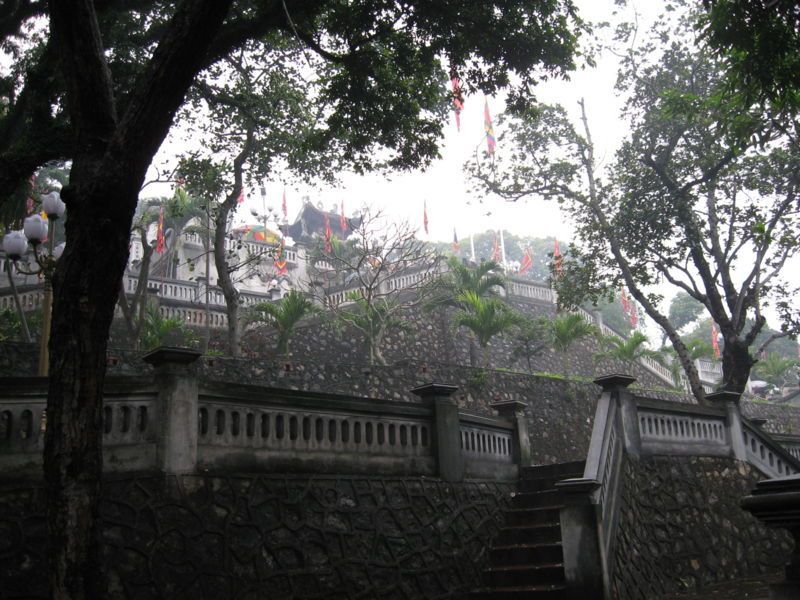
From the Shrine of Commander Hoang to the temple of the Lord
Before it honoured Tran Quoc Tang, the site held only the Shrine of Commander Hoang (Mieu Hoang Tiet Che), dedicated to Hoang Can – a local man who did great service fighting off bandits and pirates and was granted the title "Kham sai Dong Dao Tiet che" (Imperial Commissioner and Commander of the Eastern Circuit) by successive kings. He is still worshipped today in the Middle Temple.
Tran Quoc Tang (1252–1313), titled Hung Nhuong Vuong (Prince Hung Nhuong), was the third son of Hung Dao Dai Vuong Tran Quoc Tuan. During the resistance against the Mongol-Yuan invaders, he and his soldiers were garrisoned at Cua Suot – the old name for Cua Ong – guarding the north-eastern border and coastal waters.
Legend has it that after his death, local people saw him appear as a deity in the longan garden (Vuon Nhan, in today's Cua Ong) and asked King Tran Anh Tong for permission to build a shrine to him. According to historical records, the shrine was rebuilt as Cua Ong Temple, with Tran Quoc Tang as its principal deity, in the early 20th century.
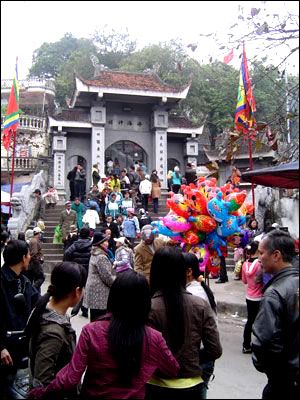
Three temples between the mountains and the sea
The complex is made up of the Lower, Middle and Upper Temples, laid out like the three legs of a tripod from the foot of the hill to the top, all facing the bay. During the war the Middle and Lower Temples were destroyed by bombing; the Lower Temple was later rebuilt on its old site, and the Middle Temple was restored between 2015 and 2017.
- Lower Temple: dedicated to the Mother Goddess Trung Thien Long Mau.
- Middle Temple: dedicated to General Hoang Can.
- Upper Temple: dedicated to the Lord (Duc Ong) Tran Quoc Tang, the most sacred part of the site.
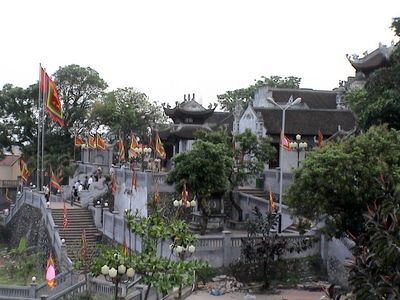
Behind the temple a green mountain range runs towards Mong Duong, two small hills stand guard on either side in the manner of the "Azure Dragon on the left, White Tiger on the right", and Bai Tu Long Bay lies in front – a classic "back to the mountain, facing the sea" setting. In 2017 Cua Ong Temple was classified as a Special National Relic.
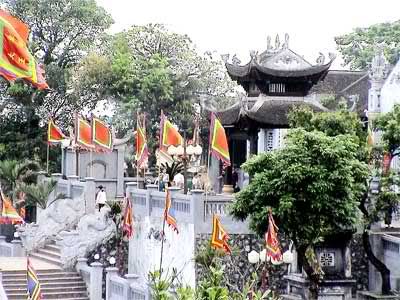
More than 30 treasured statues in the Upper Temple
The temple honours much of Tran Hung Dao's family along with many Tran dynasty generals and officials. The Upper Temple holds more than 30 statues, large and small, carved in painstaking, crisp detail and arranged in three rows:
- Front hall: Do Khac Chung (Tran Khac Chung), Le Phu Tran, Nguyen Dia Lo…
- Worship hall: Tran Quoc Tang with the generals Tran Thi Kien, Ha Dac, Pham Ngo, Tran Khanh Du…
- Rear sanctuary: Tran Quoc Tuan with his family and the generals Yet Kieu, Pham Ngu Lao, Do Hanh…
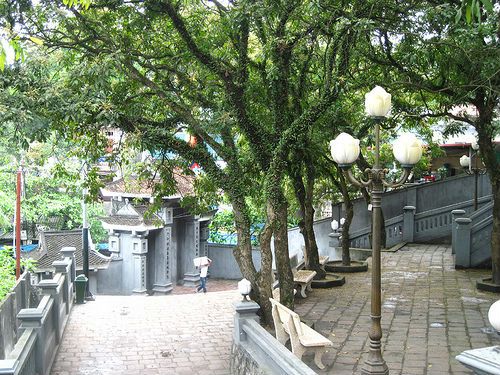
In front of the Upper Temple stands a three-entrance gate; on the left is a building where pilgrims prepare their offerings, on the right a pagoda, and behind it the tomb of Tran Quoc Tang. On a hill to the south, about 150 metres from the Upper Temple, a bronze statue of the Lord has stood since early 2018, looking straight out over the bay – a viewpoint well worth the detour.
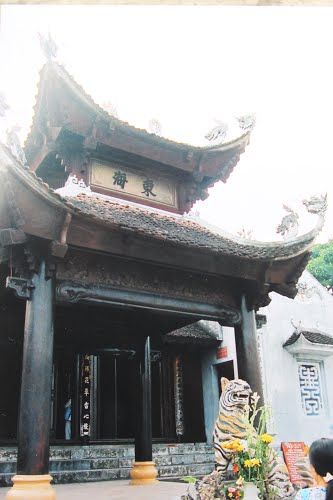
The Cua Ong Temple Festival
The temple is busiest in spring, from the first to the end of the third lunar month. The main spring festival opens on the 3rd day of the second lunar month, and there is also an autumn festival in the eighth lunar month. The Cua Ong Temple Festival has been National Intangible Cultural Heritage since 2016.
It begins with an incense-offering ceremony, followed by a procession carrying the Lord's memorial tablet from the temple to the Vuon Nhan shrine – where, legend says, he appeared as a deity – and back again, re-enacting Hung Nhuong Vuong's patrols guarding the north-eastern seas. The 2026 festival also featured a procession at sea by a flotilla of boats.
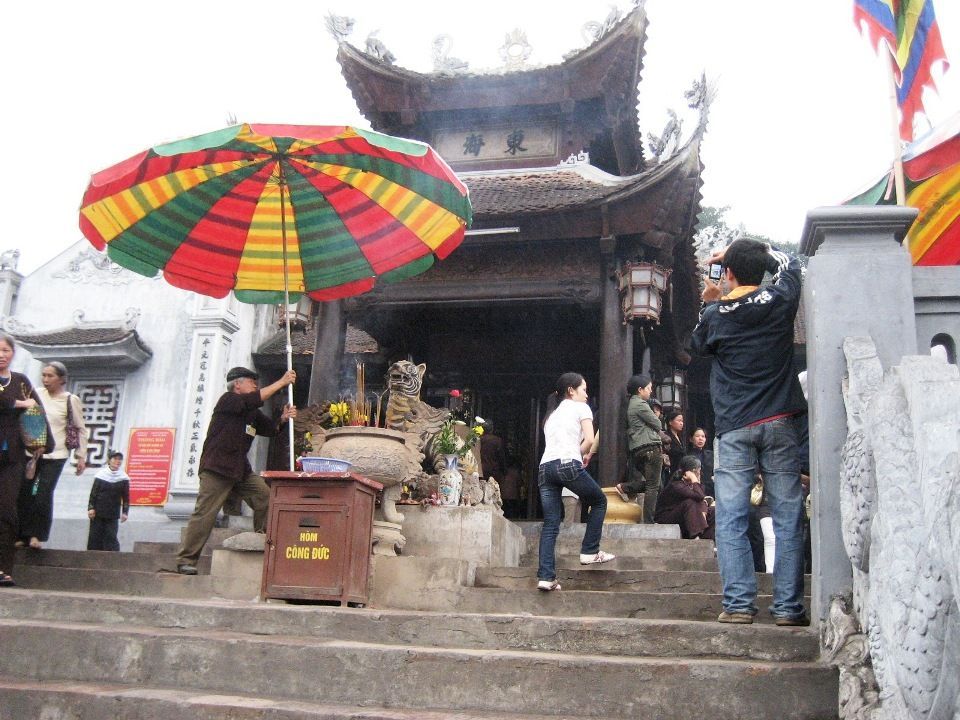
The festivities include dragon dances and contests in preparing offerings – cooking rice, folding betel quids, arranging fruit trays – along with folk games such as co boi, blindfolded pot-smashing, tug of war and stick-pushing…
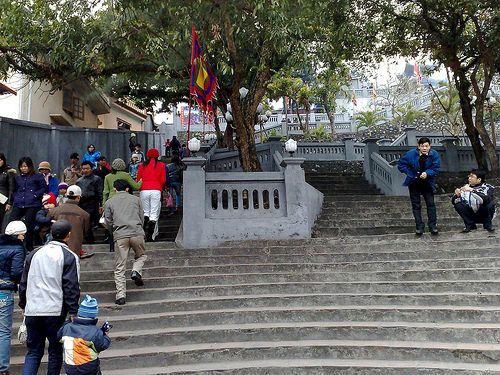
Visiting tips
- Go in the morning, when the sky is clear, for the best view of Bai Tu Long Bay from the hill.
- Dress modestly and wear comfortable shoes, as the site spreads across the hillside.
- The main festival days are very crowded, so arrive early and keep an eye on your belongings. Festival dates are announced each year by the relic management board, so check before you go.
A visit to Cua Ong Temple lets you take in the scenery of the north-eastern coast, light a stick of incense in memory of the hero Tran Quoc Tang and discover a fine cultural tradition of the coal-mining region.


